
Chillicothe Previous Resident Sources by Era
One address needs different sources for different parts of its past. Start with the present parcel and the most recent transfer, then move from recorded owners to printed household sources. The most dependable research trail preserves each source’s limit: a deed documents an interest transfer, a directory may place a printed name, a census captures an enumerator-date household, and a map shows the built block rather than the people in it. The table separates those functions so one result is not asked to prove too much.
| Source | Years it covers | Where held | What it shows |
|---|---|---|---|
| Auditor property card and map | Current roll, with sale and tax panels when available | Ross County Auditor | Parcel identity, situs, owner, mailing field, legal and sale clues |
| Recorder web access | Most records from January 1, 1974 forward, plus some older material | Official Record Search and Recorder counter | Recorded parties, document placement, date, type, and legal description |
| Chillicothe city directories | 1860–2016, with gaps | CRCPL Genealogy Room | Printed household, address, and other details present in the edition |
| Federal census | Through 1950 publicly released at the research date | Federal sources and selected CRCPL holdings | A household at the enumerator date, not a continuous address history |
| Sanborn map sets | 1884, 1890, 1895, 1900, 1909, 1914, and 1925 | Library of Congress | Building, block, and street layout, not occupant names |
| Probate estate proceedings | 1797 forward | Ross Probate–Juvenile Archives | Estate, administrator, and heir leads subject to record rules |
| Permit and zoning materials | No searchable date run verified | City or County building and planning request route | Project timing and owner or applicant clues, with possible redactions |
For a recent address, the parcel card and Recorder are often the first two stops. For an older question, start with the directory year, map date, or probate event closest to the period. When a source ends, move to its documented counter, archive, library, or request route rather than assuming the missing years are online.
Begin Chillicothe Previous Residents With a Parcel
The Ross County Auditor property search accepts a parcel, owner, or address. For a house history, use the exact street number and street name, then open the property card rather than relying on a search-suggestion row. Record the parcel number, situs address, current owner string, legal description or subdivision and lot, plus the most recent sale clue. The Auditor MAP provides the visual bridge when the parcel needs to be located among adjoining lots.
The card deliberately separates Location from Mailing Address. Location identifies the physical parcel. A mailing address tells the office where tax material is sent, which could be an owner, a trust, an estate, or another correspondence contact. Neither field gives a complete list of people who lived at the address. That distinction keeps a present property roll from being mistaken for a past household list.
Use the legal description with the street address. A parcel is the county’s identified piece of land, while a legal description is the lot, subdivision, metes-and-bounds, or other formal land wording used in recorded instruments. The legal description is the stronger matching key when a street number changes or is absent from an old document.
For card or map help at the counter, the Auditor is at 2 N. Paint St., Suite G, Chillicothe, with published Monday through Friday hours of 8–4 and phone 740-702-3080. Use the online search to identify the parcel first, then ask the office about a field or map question that the public display does not resolve.
Note: Record the search date because ownership, mailing fields, assessments, and sale information can change after a property card is viewed.
Trace Chillicothe Previous Residents Through Deeds
The Ross Official Record Search connects the parcel lead to the recorded-document trail. Its advanced controls include party names, grantor, grantee, recorded-date range, document type, document number, book, page, OCR text, legal description, parcel ID, subdivision or city or lot, and executed-date range. Use the owner name, date, and legal description together when possible. A deed can identify people connected to a transfer, but it does not establish that each named party lived at the property.
- Copy the current parcel number, owner string, legal description, and sale clue from the Auditor property card.
- Find the current owner’s acquisition instrument through the Recorder, using the recorded date or legal-description context to narrow the party search.
- Record the document number, book and page when supplied, document type, recorded date, grantor, grantee, and legal-description wording.
- Treat the acquisition grantor as a lead, then search that person as an earlier grantee while matching the same lot, subdivision, legal description, book and page, or related document context.
- Repeat one transfer at a time. When the web trail stops or a description changes, ask the Recorder for historic grantor-grantee books or indexes and compare plats or subdivision references.
- Grantor
- The person or entity conveying an interest in the recorded instrument.
- Grantee
- The person or entity receiving that recorded interest.
- Chain of title
- A documented sequence of transfers for the same land, checked through party names and legal land descriptions.
- Legal description
- The formal land identifier that can remain useful when a street address does not.
The Ross County Recorder describes its historical access and copy guidance for documents and its official search route.
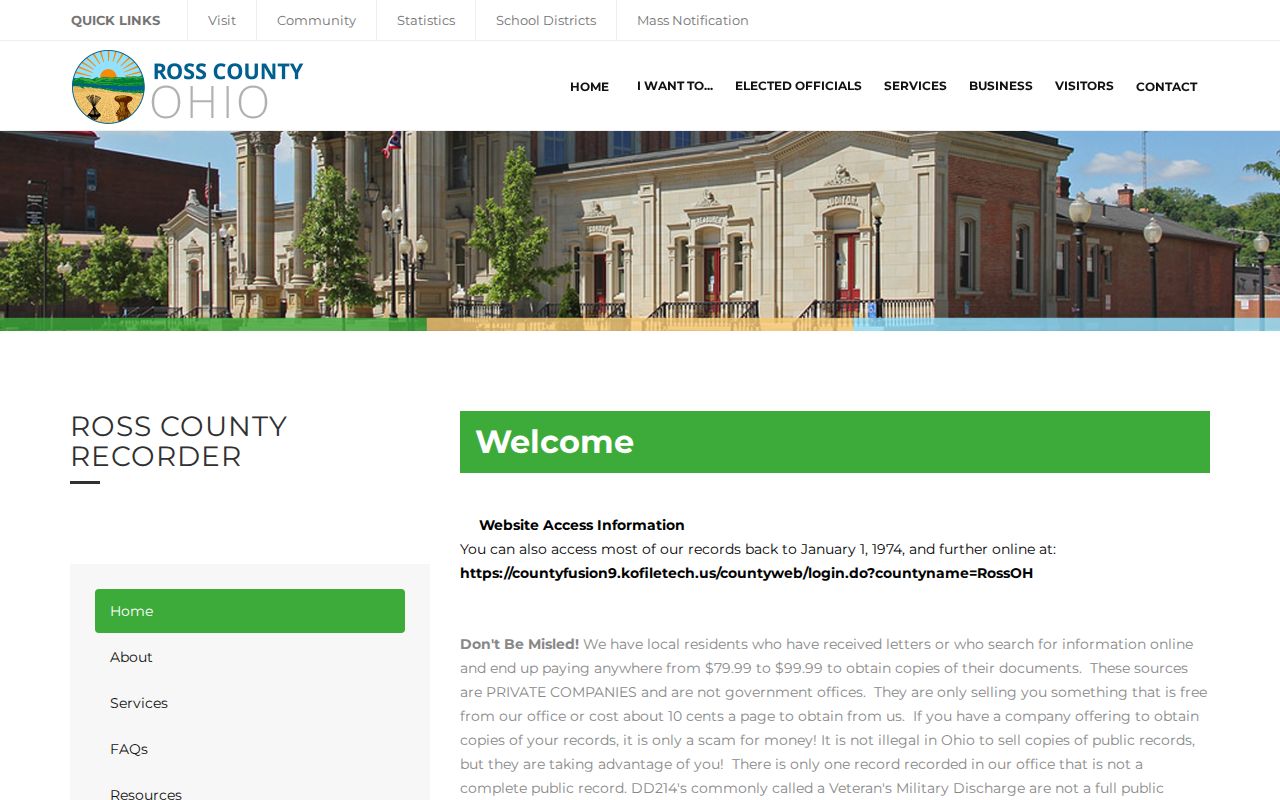
Use a document image or counter copy to test the exact parties and land wording. The portal’s OCR and index scopes are useful search tools, but the oldest hit returned is not an official promise that every earlier instrument or image is complete.
The Recorder counter is at 2 N. Paint St., Suite E, Chillicothe. It says document copies can be viewed free in courthouse offices, gives normal office copies as about $0.10 per page, and lists certified copies at $5 for the first page and $2 for each additional page. Ask the office which historic index or book best fits the date and document type.
Ross Recorder’s 1974 Online Seam
The Recorder says most records beginning January 1, 1974 are accessible online and that some reach farther back. It does not publish a guaranteed online start date for every document type. Treat 1974 as a practical access seam, not a claim that a complete chain begins there. Earlier work may require the Recorder’s historic books or indexes at the counter, along with plats and the legal-description context that ties one land reference to the next.
Some later household questions also lead to court or estate files. The Ross County Clerk says computerized court records reach November 1989, while the public request route supplies inspection and copy options at the Legal Division. Court records should be located and then verified with the custodian; they are not a substitute for a property or household record.
The Ross County Clerk public-records request guidance describes the local inspection and copy channel.
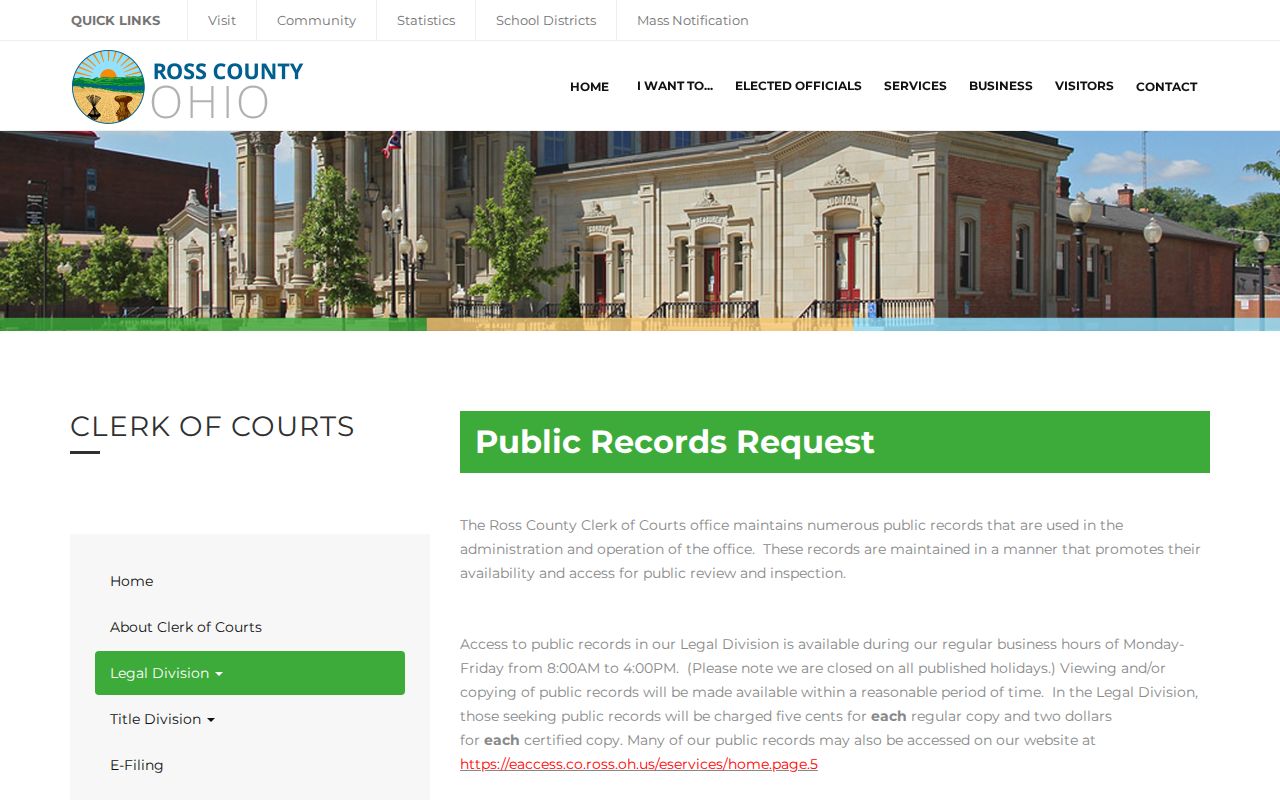
The Clerk lists regular legal-division copies at $0.05 per page and certified copies at $2 each, with review and redaction of confidential material. Give the office a narrow case, address, parcel, or date description so staff can locate the right file.
Chillicothe Previous Residents in Directories
The CRCPL Genealogy Room holds Chillicothe city directories from 1860 through 2016, with gaps, for in-house use. Staff can assist with copying or scanning to a flash drive. Ask whether the exact edition has an alphabetical, numerical telephone, street, or reverse section. The research verifies selected directory and numerical telephone holdings, but not a full criss-cross run for every year. A street or address section must be confirmed volume by volume.
Use a name found in a deed or parcel trail to look for a printed household at the nearest available directory year. Copy the name as printed, the page, the address, and any spouse, widow, occupation, or other notation only when it appears, then consult the edition’s own key. The Chillicothe city directory page explains the library shelf, catalog evidence, and entry-reading limits in greater detail.
A directory may help identify who lived here before, but it can also be absent for a year, omit a person, or use a spelling variant. A positive match should be paired with a dated census, newspaper, obituary, estate, or property record rather than treated as a complete account by itself.
Chillicothe Blocks on Seven Sanborn Dates
The Library of Congress Chillicothe Sanborn maps provide a building and block check for 1884, 1890, 1895, 1900, 1909, 1914, and 1925. Pair the map nearest to a directory or deed date with the street and legal description. The maps can show the street pattern, block, and building footprint or use at that time. They cannot identify an occupant, owner, or household by themselves.
No official source located a citywide Chillicothe street-renumbering or renaming year. If an old directory number will not match a current address, compare dated Sanborn sheets, historic maps, the legal description, subdivision or lot, and city-planning records. CRCPL or McKell Library staff may know of a street-name change file, but its existence should be confirmed rather than presumed.
Note: A map can test place continuity, while a directory, census, or record is needed to test a person connection.
Chillicothe Past Households, Census, and Obituaries
Ownership and occupancy are different trails. After a directory supplies a name and address, pair it with the nearest federal census or available CRCPL census holding. The publicly released federal decennial census reached 1950 at the research date. CRCPL identifies selected holdings for 1820, 1830, 1840, 1850, 1860, 1870, and 1920, not a complete local set. Census records place a household on the enumerator date, so they cannot fill every year between entries.
For a later family event, CRCPL’s local materials include Ross marriages from 1798–1950, divorces from 1805–1967, births from 1867–1908, a death index through 2005, and wills from 1797–1845. Its newspaper and obituary channels can provide a date or relative to carry into a custodian search. Ross Probate Archives reaches still earlier for estate proceedings beginning in 1797 and has date-specific indexes and request paths for historic series.
The Ross County Probate and marriage FAQ is the public source for current marriage-copy direction and related court guidance.
Use an obituary or estate record as a family-history endpoint, then confirm the document and date with the appropriate archive, court, health, or cemetery custodian. A person who died at or after leaving an address may still be relevant to the property trail, but that record does not prove the last place they lived.
For older probate material, the Ross Probate–Juvenile Archives is at 21 W. Main St. and publishes Tuesday and Thursday hours of 8:30–3:30 with a noon to 1 closure. Its archive page provides historic index links and counter or mail research-request paths when a record is not available through a current court screen.
Lawful use. Chillicothe house-history and family-history research should stay focused on the record and its date. Do not use a past-resident trail to track, harass, or harm a living person.
Chillicothe Permit Records Split in 2025
Permit files can add project timing to a house history, but they are not proof that an applicant lived at the address. The City zoning-certificate form links a property address and parcel ID with owner-of-record and applicant or project details. It also has fields for zoning, historic-district, floodplain, design review, variance, and permit-related decisions. No public address or permit-result search was verified before the City Cloudpermit sign-in, so the documented route is a specific request or counter inquiry.
The Ross County Building Department says that City of Chillicothe residential and nonresidential projects have been permitted through the City Building Department since July 7, 2025. The County completes applications received before that date. A request around the handoff should state the address, date range, permit or case type, and desired format, then ask both potential custodians when the date is uncertain. Expect nonpublic personal information to be redacted.
The current City building and planning channel is at 35 S. Paint St., with published weekday hours of 7:30–4:30 and phone 740-773-8980. The County Building Department’s published office is 15 N. Paint St., Suite 201, with weekday hours of 8–4 and phone 740-773-7200. This date split is a local records handoff, not evidence of a change in the property itself.