
Chillicothe Neighbor Block Records
The useful public trail around one Chillicothe address begins with the Auditor map and parcel card. It continues, when needed, through recorded documents, civic geography, permit files, and historical collections. Each source describes a different part of a block. The map gives taxable parcel geometry. The property card carries a recorded owner, situs address, mailing field, legal description, sales, value, and tax context. A deed can explain a transaction or legal-description trail. These records do not prove who occupies every address.
| Source | What It Shows About a Block | Access and Boundary |
|---|---|---|
| Auditor GIS and parcel cards | Adjoining taxable parcels plus recorded owner, situs, mailing, legal and sales context | Open map and property cards; review one parcel at a time |
| Recorder documents | Recorded parties, dates, instrument types and legal descriptions | Official index, image, counter and copy channels; not occupant data |
| BOE street and precinct tools | Street segment, precinct and available registered-voter report options | Current civic data with protected entries and ballot secrecy |
| Building and planning files | Address, parcel, owner/applicant and project or approval context | Counter or tailored request; protected details are redacted |
| CRCPL and McKell collections | Historic maps, directories, newspapers, photographs and manuscripts | Research or reading-room channels, not a live community roster |
Start with the source that matches the question. An adjoining-parcel question belongs on the map. A sale or easement question belongs in the Recorder index. A precinct question belongs with the Board of Elections. This separation makes a Chillicothe neighbor search more accurate and avoids treating an old tax-mail address or a single report as proof of a current household.
Mapping Chillicothe Neighbor Parcels
The Ross County Auditor offers a landing search labeled “Search by Parcel, Owner, or Address” and a MAP route. Use it as an address-to-parcel method, not a scan of a whole neighborhood. The research verified the map route and the card field groups, but it did not document the complete live layer list, a buffer control, or an adjacent-parcel tool label. Open the current legend rather than assuming a layer exists.
- Enter the known street address in the Auditor search or locate it in the map, then open that parcel’s card.
- Record the parcel ID, situs address, legal description, owner string, sale clue, and the distinct Location and Mailing Address fields.
- Pan or zoom to the immediately adjoining taxable parcels. Select each parcel separately and return to its own card.
- Compare parcel IDs, legal descriptions, ownership dates, and map boundaries. If a line is unclear, ask the Auditor GIS contact for help rather than treating imagery as a survey.
The flow is address → parcel card → adjoining parcels → individual cards → legal-description or deed check. For a full named-street record trail beyond the immediate block, use the Chillicothe street directory rather than stretching a parcel map into a street-wide household list.
Chillicothe Parcel Owner Limits
A recorded owner is not necessarily a resident. The Auditor card separates the physical Location from the Mailing Address, which may be where tax correspondence is sent. Trust, estate, condominium, and other ownership arrangements can widen the distance between a parcel record and a household. The card also does not name every person who lives at the property. Use the listed data as property evidence and keep the date checked with the note.
Where the map and card point to a possible earlier transaction, the Ross official record search adds a party, recorded date, document type, book or page, and legal-description route. A grantor is a person transferring an interest; a grantee is the person receiving it. Search the acquisition party and then compare the legal description, not just a street number. The Recorder says most records from January 1, 1974 and some earlier material are online. Older work may need the Recorder counter or deed-book/index help.
Note: A parcel boundary supports a property comparison, not a claim about who is in a household.
Chillicothe Neighbor Civic Records
Ross County’s public voter reporting tool can sort a report as “Walking List (sorted by Voter Address)” or “Precinct, Walking List.” It also offers precinct and district filters, options to group a household, include mailing addresses, and include voter districts. The Board of Elections links Street Report Generation and a precinct and polling-place page that can work from a street segment. These are useful ways to understand civic geography around a block, not a mandate to compile personal profiles.
Use the Ross voter reporting tool only for its stated, live report options. A report’s date matters. Registration can change, and a report may not include a protected participant or all people at an address. It can show current public registration data and participation history under applicable law, but it never shows ballot choices. Direct correction or access questions to Ross BOE.
For an incident report or official response tied to an address, use the Ross County Sheriff report request route rather than treating neighborhood records as an investigation tool.
The Sheriff’s request channel is a formal records process with investigation and juvenile limitations, not a source for identifying neighbors.
Chillicothe Neighbor Permit Records
Permit and zoning materials can add a dated block context without becoming evidence of residence. The City’s published zoning-certificate application identifies property address, parcel ID, owner of record, applicant, project or use, and planning-related review fields. No public address-result search was verified before sign-in at the City’s Cloudpermit route. Request the relevant holding office by address, date range, permit or case type, and desired format. Expect review and redaction of nonpublic details.
Chillicothe has a real two-office timing issue. The Ross County Building Department says City residential and nonresidential projects moved to the City Building Department on July 7, 2025, while the County completes applications already received before that change. A request covering work near that date should identify the period and ask the City and County channels which one has the record. That is a project-history question, not a way to identify present neighbors.
Note: A permit can document a proposed or approved project; it does not prove that an applicant or contractor lived on the block.
Chillicothe Historic Neighbor Evidence
Past blocks need historical sources, not a modern parcel screen. CRCPL’s city-directory collection runs from 1860 through 2016 with gaps. Its newspapers, yearbooks, obituary path, selected census material, and local-history files can add dates and names to a documented address trail. Ask library staff for the relevant year and whether an address or reverse section exists. If only alphabetical material is available, start with a known household name and compare adjacent years carefully.
Seven digitized Chillicothe Sanborn map editions, dated 1884, 1890, 1895, 1900, 1909, 1914, and 1925, are available from the Library of Congress. They can show a building, street, and block at the map date, but they do not identify occupants. Pair a map with a directory, newspaper, probate, or Recorder record rather than projecting a historic block onto a current roster.
McKell Library offers another local route for historic block questions through maps, photographs, diaries, ledgers, family Bibles, and manuscripts. Its 19th-century material is especially strong, while the collection reaches beyond that period. Research is available by walk-in, appointment, phone, mail, or email; it is not a public membership file.
Chillicothe Community Directory Gap
No official current Chillicothe neighborhood-association, homeowners-association, or household directory was verified. That absence matters. It would be inaccurate to name associations, imply a boundary, or promise a membership roster. The Chillicothe Ross Chamber does have a business and member directory with a community-service and associations category, but it is an organization lead, not an authoritative neighborhood map or resident list.
| Civic or Community Source | Verified Local Evidence | Proper Use |
|---|---|---|
| Ross County Board of Elections | Precinct, district, street-report, and voter-report tools | Check civic geography and current public report controls |
| CRCPL Genealogy Room | Directories, newspapers, maps, yearbooks and local indexes | Research a historical address or block |
| McKell Library | Photos, maps, manuscripts, diaries, ledgers and family material | Ask about a historic organization, street, school, or block |
| Chillicothe Ross Chamber | Business/member categories, including community organizations | Find publicly listed organization contacts without inferring resident coverage |
Publicly advertised meetings or office contacts can be useful for civic participation. They cannot fill the gap created by an unverified neighborhood or HOA directory.
Official Chillicothe Neighbor Sources
Official records and commercial neighbor-lookup products are not the same category. Official sources identify their custodian, fields, and access limits. They may be incomplete by design because a record has a particular legal purpose. Commercial products may combine sources with an uncertain update date, unclear match method, or stale address. Neither category turns a parcel record into proof of a current household.
| Category | Useful For | What Must Be Verified |
|---|---|---|
| Official parcel and Recorder records | Parcel identity, recorded owner, legal description, and instrument placement | Document date, image or office copy, and the ownership-versus-occupancy distinction |
| Official BOE and court channels | Stated civic or public case information | Live scope, protected records, posting delay, and custodian confirmation |
| Commercial neighbor tools | A possible lead to compare with a source record | Source, date, matching accuracy, and whether the item is public or protected |
The Ohio Public Records Act, R.C. 149.43, is the relevant state framework for requesting public government records. It supports inspection and copies subject to exemptions, but it does not create access to protected information.
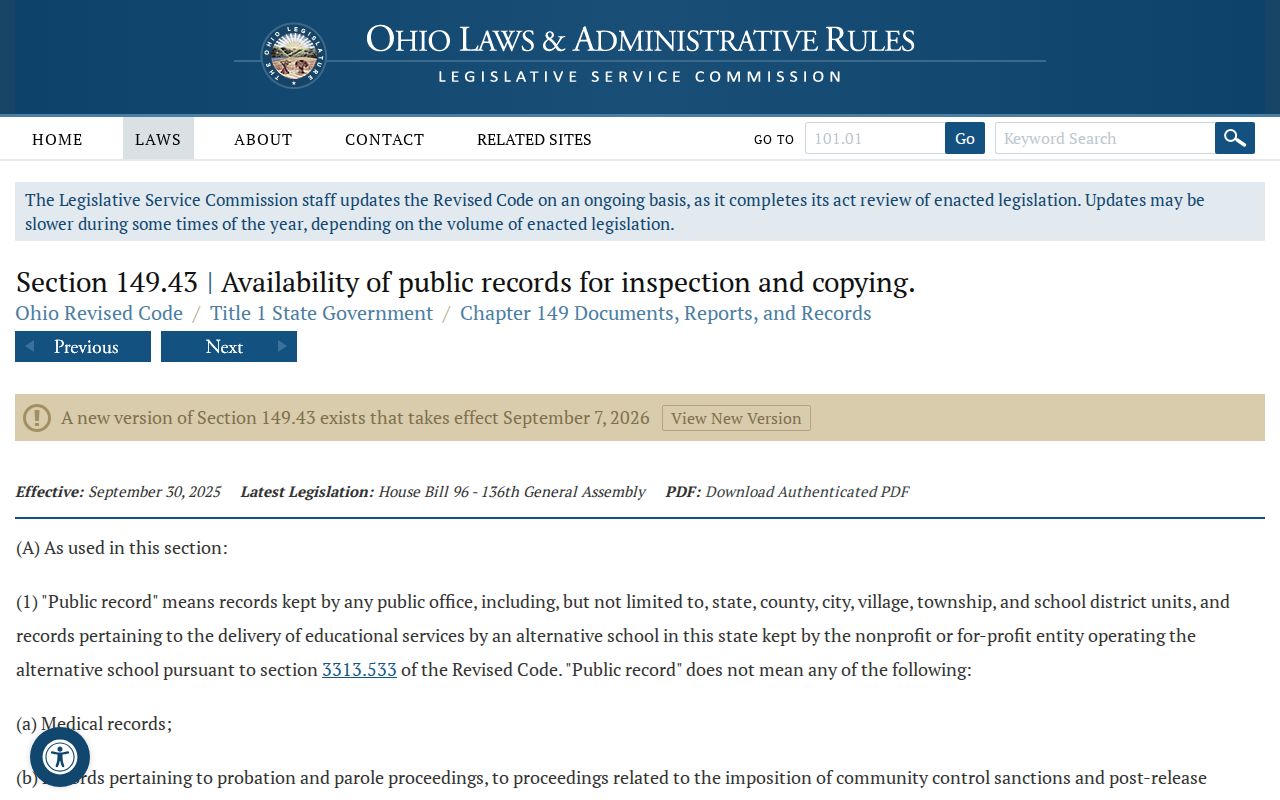
When an online tool does not supply the needed public record, direct a clear, limited request to the office that holds it.
Chillicothe Neighbor Privacy Limits
Privacy limits are part of any lawful neighbor inquiry. Ohio Safe at Home gives qualifying participants a substitute address for covered government records and withholds their name, residence, and precinct information from statewide voter displays and pollbooks. Do not treat an absent voter or property display as evidence that someone is not in the area. Ballot choices, DMV personal information, protected court data, juvenile and adoption records, and other confidential fields are not a neighbor-search substitute.
Ohio R.C. 149.45 supplies an online-redaction process for designated public service workers and former workers. The Ohio Attorney General’s redaction-request forms explain that the form must be sent to the public office maintaining the record. The Attorney General does not forward or decide the request. Correct a wrong official record with the Auditor, BOE, Clerk, Recorder, registrar, or other actual custodian.
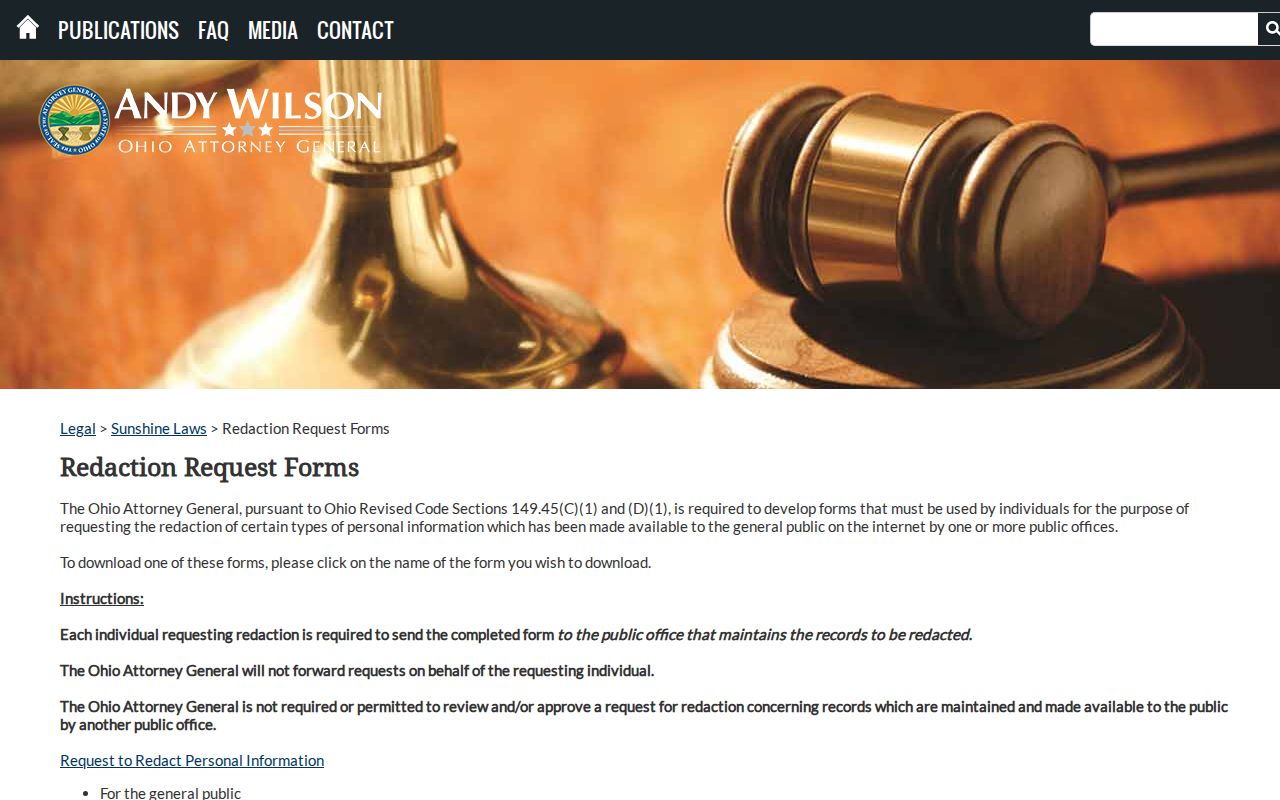
The redaction process is record-specific. It is not a promise that every accurate public record can be removed from every source.
Lawful use. Use Chillicothe neighbor records for lawful personal and civic research. Do not use any result to stalk, harass, threaten, or harm another person.