
Chillicothe City Directory Holdings
The historical shelf starts at the Chillicothe and Ross County Public Library Genealogy Room. Its collection list identifies Chillicothe city directories from 1860 through 2016, but expressly says that not every year is present. That is the reliable description of the run. Ask for a specific year, edition or publisher, and ask whether a street or address section exists for that volume. The directory itself is a historical clue, not a complete roll of everyone in town.
| Collection | Years or scope | Where held | Access |
|---|---|---|---|
| Chillicothe city directories | 1860–2016, with gaps | CRCPL Genealogy Room | In-house consultation; staff-assisted copying or flash-drive scanning |
| Cataloged directory editions | Examples include 1860–61, 1876–77, 1900, and later serial issues | CRCPL catalog | Confirm the physical edition before relying on a publisher or index |
| Ross County Genealogical Society directory leads | Selected business, city, survey, and numerical telephone directories | Society catalog | Catalog route; inspect the actual volume and its key |
| Local newspapers on microfilm | Named runs from 1800 onward | CRCPL Genealogy Room | In-house research; later Gazette access has a library-card route |
| Family and probate research materials | Dates vary by series | CRCPL, Probate Archives, and McKell Library | Index, counter, reading-room, appointment, or request path |
A catalog hit proves that an edition is described, not that every page is digitized or that a full address index exists. The closest substitute for a gap is usually another local source from the same period, such as a newspaper notice, a probate index, a map, or the nearest census. Start by recording the exact volume consulted so another search can be repeated.
Note: A missing directory year is a collection gap, not proof that a household moved or disappeared.
Chillicothe Directory Room Access
CRCPL keeps the relevant materials in the second-floor Genealogy Room at the Main Library, 140 S. Paint St. Materials are for in-house use, though staff can help with copying or scanning to a flash drive. Published research contacts are 740-702-4145 and research@crcpl.org. General library hours are Monday through Thursday 9–7 and Friday and Saturday 9–5. Contact the room before a special trip when an edition, microfilm title, or address section matters.
The Ross County Genealogical Society catalog is a useful way to identify selected local directory and telephone holdings before asking to see a volume.
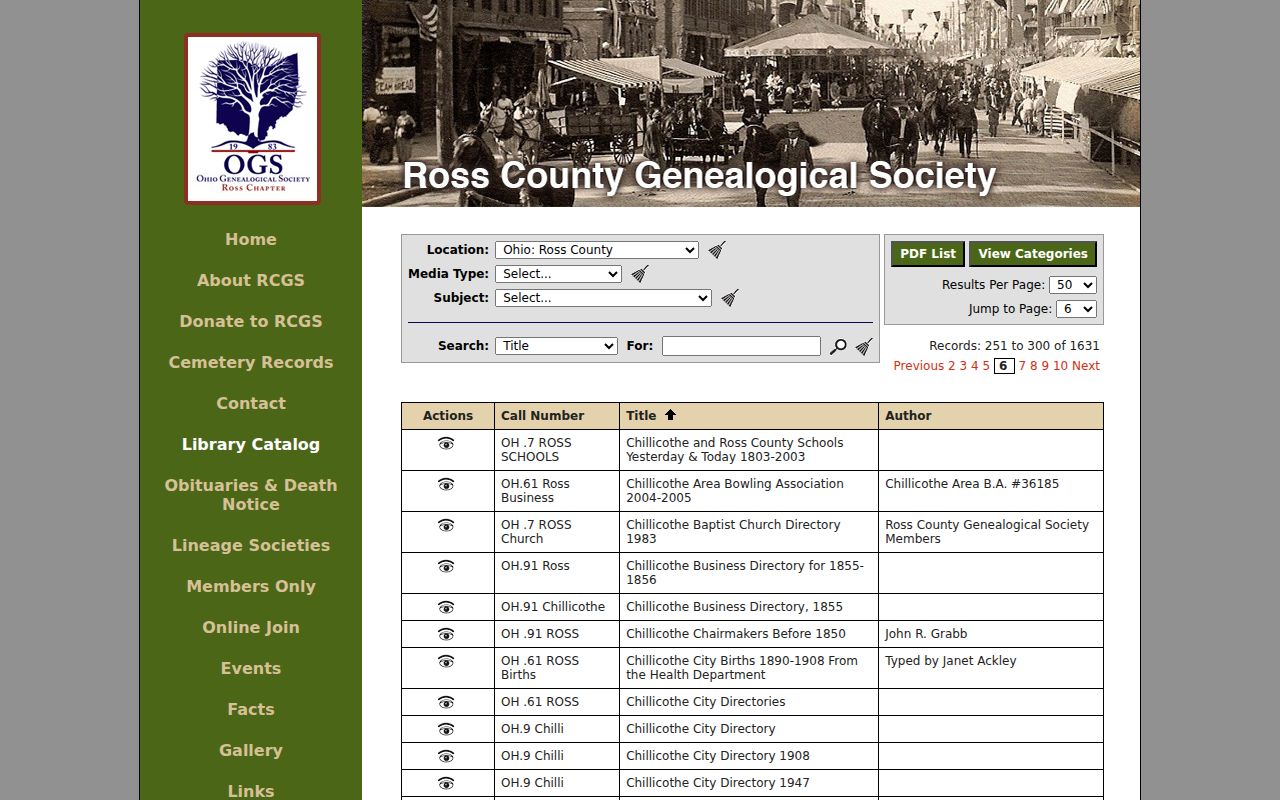
Catalog entries help narrow a request, but the printed volume and its own introductory key remain the authority for how an entry is arranged. Bring the surname, spelling variants, a rough date, and a known street if one is available.
CRCPL also lists yearbooks, family-Bible and family-history files, cemetery material, local obituary tools, military material, and selected federal census years. Those adjacent holdings make the room a better follow-up when a name appears only briefly in a city directory.
Chillicothe City Directories Across 1860–2016
The 1860–2016 span is a useful number, not a promise of uninterrupted annual publication. CRCPL’s catalog records examples such as Williams’ Chillicothe Directory for 1860–61, a Wm. Purdy & Co. directory for 1876–77, and J. Wiggins’ Chillicothe City Directory for 1900. Later serial entries are associated with R. L. Polk, Mullin-Kille, and Johnson. These examples establish editions that can be requested; they do not establish a continuous publisher history.
| 1860–61 | Catalog evidence identifies a Williams’ Chillicothe directory edition. |
|---|---|
| 1876–77 | A Wm. Purdy & Co. edition is cataloged as a local directory example. |
| 1900 | The CRCPL catalog identifies a J. Wiggins city directory. |
| 1955–1980 | The Genealogical Society catalog lists selected Chillicothe Ohio Con Survey Directory issues and supplements. |
| Through 2016 | CRCPL’s collection statement reaches 2016, with unavailable years within the run. |
The Society catalog also identifies city directories for 1908, 1947, and 1952, plus a Mullin-Kille numerical telephone directory. A numerical telephone book should not be assumed to be a full reverse city directory. Ask staff how its entries are ordered before treating it as an address tool.
How a Chillicothe Directory Entry Reads
No public scan in the researched collection supplied a verified Chillicothe entry or its abbreviation key. Read each volume on its own terms. Find the surname in the alphabetical or householder sequence, preserve the spelling exactly as printed, and photograph or copy the edition’s key before expanding any shorthand. Some historical directories may print more detail than others, so capture a field only when it actually appears on the page.
| Printed name | Record the full name, initials, prefixes, and the volume’s spelling without modernizing it. |
|---|---|
| Householder sequence | Note whether the person appears in an alphabetical or household arrangement and the page number. |
| Spouse or widow wording | Copy it only if printed; it can point to a family relationship or an event to test elsewhere. |
| Occupation or employer | Preserve the printed wording when present rather than guessing from an abbreviation. |
| Street address and status marks | Transcribe the address and any abbreviated notation, then consult that edition’s own key. |
- Criss-cross directory
- A directory arranged by street or address rather than only by surname. CRCPL should confirm whether a particular year has one.
- Householder index
- An arrangement centered on the household name; it is not automatically a list of every person at an address.
- Abbreviation key
- The publisher’s explanation of shorthand, usually near the front of that edition. It is the only safe way to interpret local marks.
For an address question, ask whether the particular edition has a street, reverse, criss-cross, or telephone section. The available catalog evidence supports selected numerical telephone material, not a complete verified reverse-directory run for every year.
Chillicothe Directories and Newspaper Gaps
Newspapers can bridge a year the directory shelf does not hold. CRCPL has Scioto Gazette microfilm beginning in 1800, the Freeman’s Journal and Chillicothe Advertiser for July 11 through September 26, 1800, and a Chillicothe Gazette run through 2023. It also names the Chillicothe Advertiser, Chillicothe Leader, Independent Republican, Freedonian, and Clarksburg Star among its local runs.
For 2024 and later, the library identifies online Chillicothe Gazette access through the Ohio Historical Newspaper Collection for cardholders. Search a name alongside an address, organization, or relative, then compare the date with a directory edition. An advertisement, notice, or obituary can strengthen a time-and-place lead, but it does not replace the printed directory or a vital record.
Note: Preserve the newspaper title and issue date because Chillicothe titles and access routes change across eras.
Chillicothe Maps Beside Directory Years
A directory can name a street while a map shows the block or building pattern at the time. The Library of Congress Sanborn collection supplies seven dated Chillicothe sets: 1884, 1890, 1895, 1900, 1909, 1914, and 1925. The cataloged 1884 set has 11 sheets and the 1909 set has 38. These maps are free to consult online, but they identify building and street geography, not occupants.
The City of Chillicothe history page provides the local historical context behind early government, transportation, Camp Sherman, and later development.
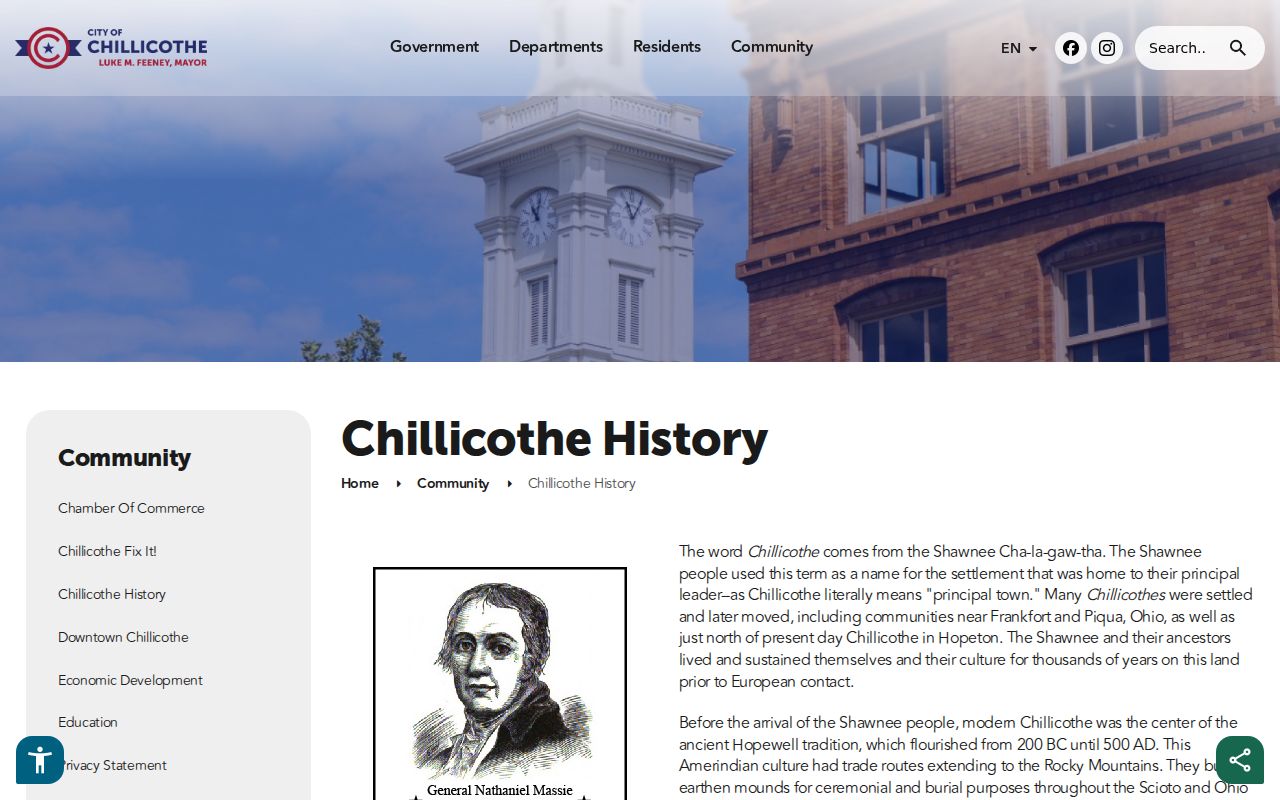
Use the history context to frame a research question, then rely on a dated map and the matching record to establish a specific block. When a modern number will not match an old one, compare map sheets, the lot or legal description, and local-library guidance instead of assuming a citywide renumbering occurred.
Chillicothe City Directories for Family Trails
A household trail works best when each entry is tied to its source and year. City directories can place a printed name and address between federal census years. CRCPL lists selected census holdings for 1820, 1830, 1840, 1850, 1860, 1870, and 1920. Federal schedules through 1950 were publicly released at the research date, but the library does not claim a complete local census run. Pair a directory edition with the nearest available census instead of filling the gap with an assumption.
- Start with the earliest confirmed name, street, or edition year and copy the entry exactly.
- Check the next available directory, not merely the next calendar year, and log changes in spelling, address, or printed family wording.
- Ask whether that edition includes a street or numerical section before drawing conclusions from an address.
- Compare the nearest available census, newspaper notice, cemetery reference, or obituary lead for the same household cluster.
- Use probate, deed, or vital-record custodians to verify a relationship, estate, or property event that the printed entry only suggests.
A name vanishing from a city directory can mean a move, death, changed listing practice, a spelling change, or a missing volume. Probate and obituary material may help at the end of a family trail, while the Chillicothe previous residents page focuses on following one address backward through deeds and household sources.
Probate and McKell Household Records
The Ross Probate–Juvenile Archives supplies an unusually early official channel around a directory household. It identifies estate proceedings and inventories beginning in 1797 and local marriage licenses beginning in 1798. Its marriage, birth, death, and probate guides divide records by era, so date the event before selecting an index, counter request, or archive route. The archive is at 21 W. Main St. and publishes Tuesday and Thursday hours of 8:30–3:30, with a noon to 1 closure.
The Probate Archives page is the source for its historic-record and request pathways.
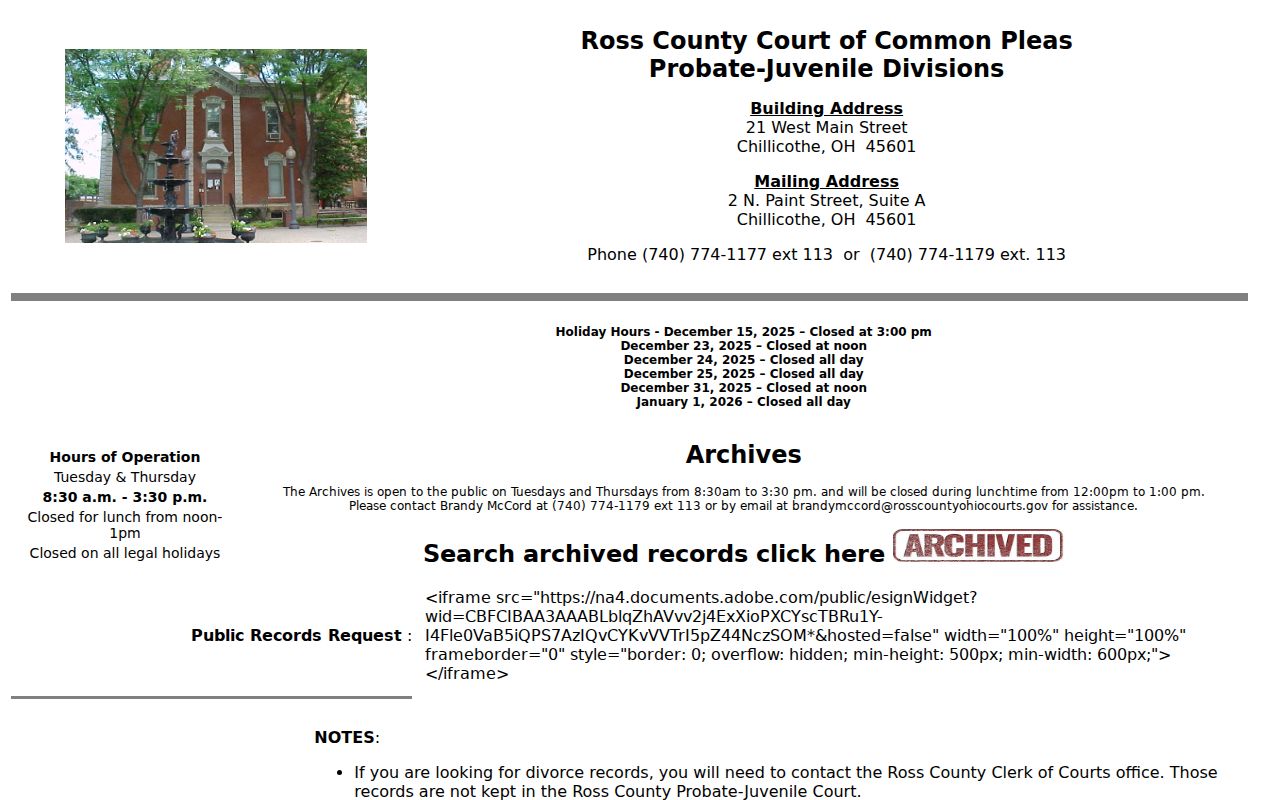
An estate or marriage index can supply a date, relationship, or name form to test against a directory. It does not turn a directory entry into proof of every household member.
McKell Library at the Ross County Historical Society adds family Bibles, ledgers, diaries, maps, photographs, and manuscripts. It offers walk-in access Tuesday through Thursday, appointment time Friday and Saturday, and mail, email, or telephone research requests. Rare material remains in the reading room, and the stated nonmember admission is $2. This is the right local channel when a directory leaves a family or house question unresolved.